
Can you tell us about your journey at Impresoft Syscons?
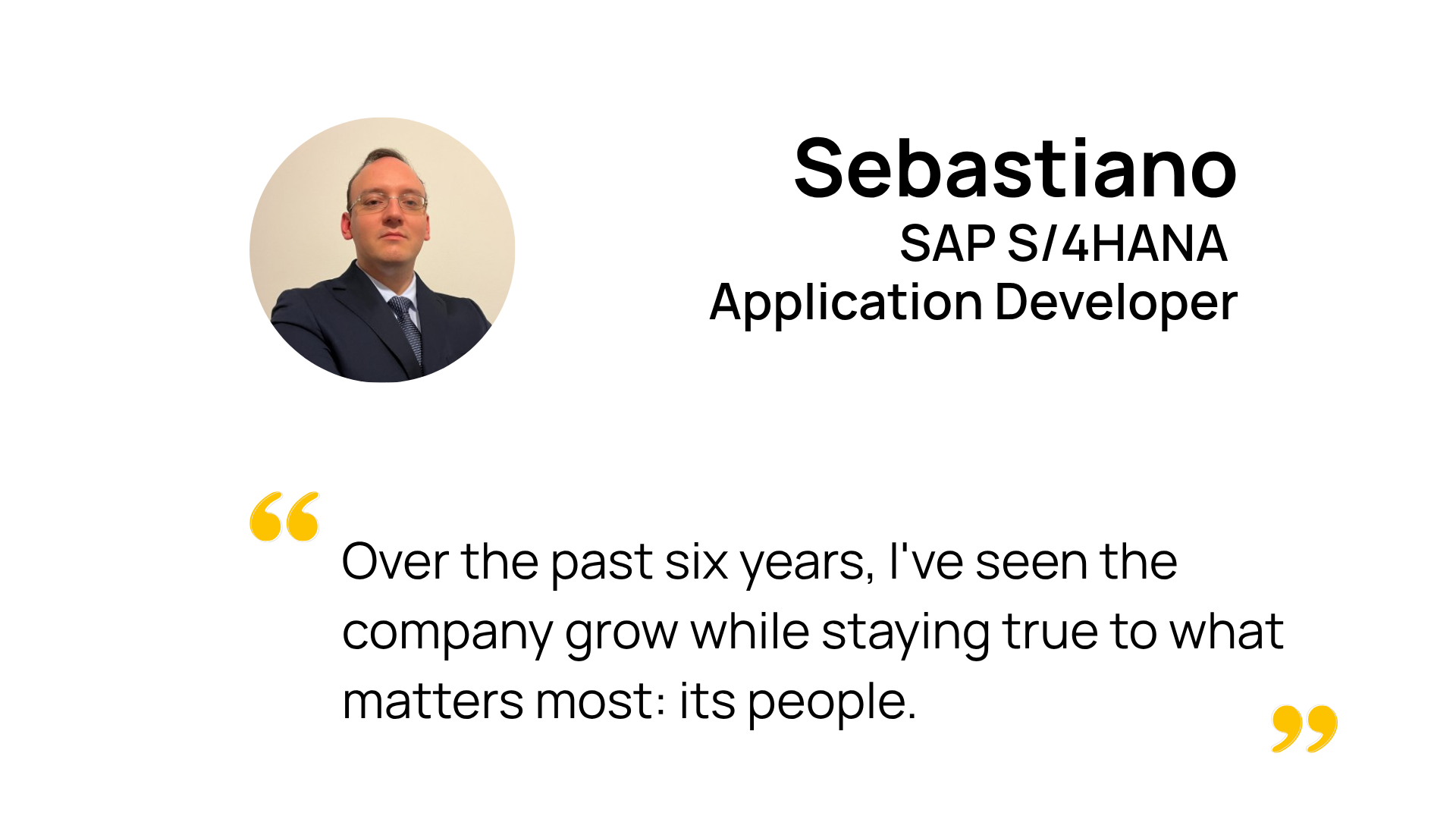
I joined Syscons on March 18, 2019, after participating in an Academy focused on SAP. It was a somewhat unusual start: I hadn’t yet had the chance to get to know the company well during the training program, and the interview didn’t take place until the end of the Academy.
At the time, Syscons was a much smaller company than it is today. I joined the SAP development team as a programmer, a role I still hold today, although naturally with very different skills and responsibilities compared to when I started.
What were your first few months at the company like?
At first, I went through a gradual training process. The first week was mainly devoted to theoretical learning and initial hands-on exercises, then I started working on increasingly practical tasks.
One of the things I remember most fondly is how helpful my senior colleagues were. Whenever I had questions or needed support, I always found someone willing to give me their time and attention. This approach helped me immensely as I grew and developed my professional independence.
Looking back, what were the most significant moments in your professional growth?
The COVID-19 period was definitely an important phase. Working entirely remotely required greater autonomy and organizational skills. It was a challenging time, but it allowed me to accelerate my professional growth.
I also had the opportunity to temporarily collaborate with another company within the group—an experience that allowed me to engage with new contexts and acquire additional skills.
Today, I continue to evolve alongside technology: the SAP world is undergoing a period of intense innovation, and I’m increasingly focusing on new development methods and cutting-edge technologies.
What exactly do you do as an SAP Developer?
My role involves transforming customer needs into technical solutions. We work closely with business analysts, who gather requirements and translate them into functional analyses. That’s where the development team comes in.
I’m responsible for designing and implementing the requested solutions, but I also support my colleagues in analyzing more complex issues through debugging and in-depth technical analysis.
It’s a job that requires precision, continuous learning, and a lot of collaboration.
In addition to your role as a developer, have you had other experiences at Impresoft Syscons?
Yes, and those are among the experiences I look back on with the greatest satisfaction. After joining through an Academy program, in the years that followed I had the opportunity to participate as an instructor in several editions of the same program.
It was a very rewarding experience: being able to guide new talent through their first steps in the SAP world allowed me not only to share my expertise but also to give back some of the support I had received when I was just starting out.
How would you describe your team?
The word that immediately comes to mind is collaboration.
Over the years, the team has grown and evolved, but that spirit of mutual support I found from day one has never wavered. Everyone brings different skills to the table, and it’s precisely this diversity that is such a great asset.
When someone needs help, there’s always someone willing to step in. And it’s not just about solving a problem: often, these interactions become an opportunity to learn something new and grow together.
You’ve seen our company change a lot over the years. What has remained the same?
Without a doubt, our focus on people.
Today, the company has grown significantly, with new offices, new teams, and many more people involved. Despite this, we haven’t lost that sense of closeness and approachability that characterized Syscons in the beginning.
That’s something I consider anything but a given.
How would you describe the work environment to someone considering joining Impresoft Syscons?
I’d describe it as an open, informal, and authenticenvironment .
Here, there are no rigid barriers between roles or organizational levels: we work together, exchange ideas freely, and build professional relationships based on mutual trust.
Even during the busiest times, we always manage to find a way to lighten the day, share a joke, or discuss things calmly. It may seem like a small detail, but when you spend many hours working on complex projects, it makes a huge difference.
What would you say to someone thinking about applying?
I’d tell them that here they’ll find an environment where they can truly grow.
They’ll have the chance to learn from skilled colleagues, put their skills to the test on real-world projects, and work in an environment where collaboration isn’t just a buzzword—it’s something we live by every day.
For me, after more than six years, this continues to be one of the most valuable aspects of Syscons.
What convinced you to join Syscons during the interview?
What struck me right away was the idea of a company that cares about people, not just the organization’s interests. I was looking for an environment that was “tailored” to individual growth, and Syscons gave me exactly that.
Plus, the young and dynamic atmosphere seemed perfect for staying up to date: in a field like IT, if you don’t keep learning and experimenting, you risk falling behind.
Once you joined, were your expectations met?
Yes, absolutely. I already knew someone who worked at Syscons. This colleague had told me a lot about the work environment and the projects, so my expectations were high. And they were met: I’ve been happy here both personally and professionally. For me, both aspects are essential: if one or the other is missing, it becomes difficult to carry out projects with enthusiasm.
You transitioned from an internal IT role to the Integration team. How did that change come about?
It was a natural transition. While working in internal IT, I’d already been involved in integration-related tasks, such as Power Automate workflows. A current colleague on my team noticed this interest and suggested I try out the Integration team.
The initial training wasn’t easy—I prefer to learn by doing—but it was the right push. After getting certified, I was immediately involved in a real project with my manager, and from there I was able to learn quickly, both about technical integration and consulting aspects, such as client interaction and managing estimates.
What kind of projects do you work on today as an Integration Consultant?
I work on different platforms and with different clients, which has allowed me to develop cross-functional skills. In short, we manage and orchestrate data: we take it from a source system and move it to target systems, transforming it into the correct format and ensuring that every process runs smoothly.
For example, I worked on a project for a client related to their new e-commerce site: we handled all stages of the order process—from the warehouse to customer communications, including pricing and balances—by orchestrating data across different systems.
What’s the work environment like at Syscons?
There’s a very collaborative atmosphere. Even though integration work can be done almost entirely remotely, I often go into the office: for me, social interaction is essential. Working alongside people from other teams is a real plus, because it allows you to get to know the company better, understand who does what, and even create useful connections between different projects.
What would you say to a young person about to join Syscons as an Integration Consultant?
It’s not an easy role to explain, but the heart of our work is enabling different systems to communicate through data. It’s a stimulating job, because every project is different and forces you to grow.
To anyone thinking about joining Syscons, I’d say: go for it. It’s a company that challenges you, supports you, and gives you the chance to try out different roles. I’m living proof of that: I joined in one role, but my curiosity and desire to learn led me to change paths and find my way into integration.